The End of the Spreadsheet Era
By LumaVista Team

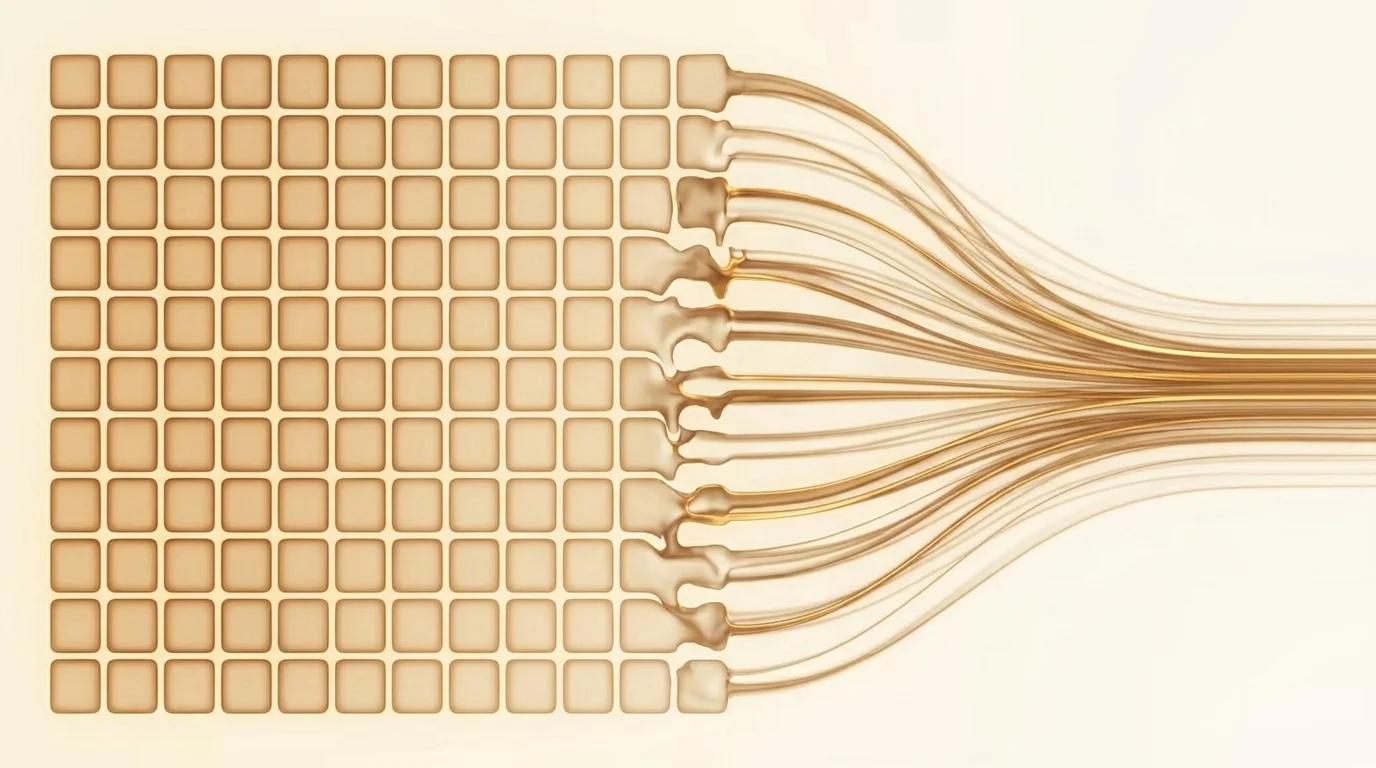
It’s 11:47pm on a Sunday. You’re three tabs deep in a workbook that ties this month’s pipeline to your associate utilization to the WIP report your bookkeeper sent Friday. Half of what you’re doing is moving numbers between cells. The other half — the part that actually matters — is the moment you stop, look at one row, and decide whether to push back the close on the Mercer engagement.
That moment is the only reason you’re up at 11:47. Everything else is plumbing.
You wouldn’t have phrased it that way a few years ago, but you can feel it now. The spreadsheet you’re squinting at is a direct descendant of VisiCalc, the program Dan Bricklin shipped on an Apple II in 1979. Forty-seven years. Every “modern” business app since — your CRM, your ERP, your project tracker, your dashboard tool, the BI platform your COO won’t shut up about — is the same skeleton in different clothes.
The bargain underneath has never changed. Human, please move data between cells. We will calculate the result. That bargain is what’s ending — not because spreadsheets got faster, but because the calculation was never actually why you were there.
The cell became the unit of business
Pull up any tool your firm pays for. Look past the colors and the marketing.
Your CRM is a spreadsheet of opportunities. Your project tracker is a spreadsheet of tasks with due dates. Your timesheet system is a spreadsheet of hours by associate by client. Your dashboard tool is a spreadsheet that’s been pivoted, charted, and given a corporate logo. Even the AI-assisted analytics product the rep demoed last month — strip the chrome, and the underlying data model is rows, columns, and cells.
This isn’t an insult to those products. It’s a description of how business has been organized for two generations. The cell — a single piece of data with a label, a value, and a position in a grid — became the atomic unit of business thought.
Before VisiCalc, the same shape lived in green ledger paper. After VisiCalc, it migrated into software, then into databases, then into the cloud. The substrate kept changing. The shape didn’t.
And once your unit of thought is the cell, everything else conforms to it. Your reporting cycle becomes “extract data into cells, manipulate cells, paste cells into a deck.” Your hiring pyramid becomes “junior people who fill cells, mid-level people who reconcile cells, senior people who interpret cells.” Your week becomes a sequence of meetings where someone pulls up a workbook and the room reads the cells out loud.
You can hear this in the language firms use about themselves. “Data-driven.” “Analytics-led.” “Numbers people.” Every one of those phrases is a polite way of saying: we have organized ourselves around the cell as the place where truth lives, and the meeting where we look at the cell as the place where decisions get made. That sounded like sophistication for forty years. It’s about to sound like a description of where the friction is.
The cell didn’t just describe the work. It shaped what the work was allowed to be.

What the spreadsheet was actually for
Here’s the part nobody said out loud, because nobody had to. The spreadsheet was never really for the calculation. The calculation was the visible work. The actual work was something else.
Think about what you’re doing at 11:47pm. The arithmetic — multiplying utilization by billable rate, summing pipeline by stage, reconciling the WIP against the bookkeeper’s numbers — is trivial. Your laptop did it in microseconds. You’re not adding value by re-running SUMIFS. The thing you’re adding, the thing the firm pays you to do, is the moment you look at the reconciled number and say we need to push the Mercer close to next month, because if we close it on the 30th the realization will compress and the partner bonus structure will tilt the wrong way.
That sentence has roughly seventeen kinds of judgment in it. You read the room — who reports to whom, who’s having a hard quarter, what the partner conversation will sound like. You weigh second-order effects — what does deferring revenue do to next month’s pipeline confidence call? You apply taste — this is the kind of trade-off we make in this firm, and that other one isn’t. None of that lives in the cell. None of it could.
The spreadsheet existed because computers couldn’t do that part. They could move numbers; they couldn’t decide what to do once they saw a number. So we built a tool that lined up the numbers in front of a human and said: over to you. The cell was a waiting room for judgment. The grid was a way of saying here is everything organized, please come and decide.
That’s the bargain we’ve been living inside for forty-seven years. The machine does the moving. The human does the deciding. Your week, your job description, your firm’s org chart, the way you bill clients, the way you train juniors — all of it is downstream of that one division of labor.
It worked because there was no alternative. Now there is.
What just changed (and what didn’t)
The change isn’t that AI got smart. It’s much more specific than that.
Two things showed up at roughly the same time, and they matter together in a way they don’t matter apart. The first is that large language models can hold context — they can read a fifty-page document, a CRM history, a Slack thread, and a P&L in the same breath, and reason across them the way a senior person does.
The second, which is the part most people miss, is that you can put deterministic gates around what those models do. Hard rules. Budgets that can’t be overspent, jurisdictions that can’t be crossed, outputs that have to match a schema or get rejected, audit trails written in code rather than summarized in prose.
Either one alone isn’t enough. A model on its own is a brilliant intern who occasionally invents quotes from books that don’t exist — useful, dangerous, ungovernable. Pure rule-based code on its own is what you’ve already got, just with more cells. But the combination — judgment that holds context, wrapped in code that holds the line — is why the best AI systems use both, and why the demos always look so much better than the products you’ve actually deployed.
What this means in practice is that, for the first time, you can build something that makes the judgment call — not the calculation, the call — and have it be enforceable, auditable, and trustworthy enough to put real work on top of. The “should we push the Mercer close” question isn’t going to have its answer typed by a human into a spreadsheet cell. It’s going to be proposed by a system that has read everything you have read, weighed it against rules you defined in advance, and presented the recommendation alongside the receipts.
The cell is no longer the only place a decision can live. That’s the change. Everything else — the new org chart, the new rhythm of the week, the death of the WIP-reconciliation slog — flows from that one fact.
What didn’t change: the work itself. Clients still want what they wanted. The partners still want what they wanted. The market still rewards firms that decide well and punishes firms that don’t.
The judgment isn’t going away. The waiting room is.
Why this is bigger than “AI is changing things”
Every wave of business technology in living memory has automated the same thing: the moving of data.
The typewriter automated the moving of words from a draft into a fair copy. The spreadsheet automated the moving of numbers between rows. The ERP automated the moving of transactions between departments. Cloud computing automated the moving of files between servers. SaaS automated the moving of records between vendors.
Each of these was real. Each one created a generation of jobs whose entire purpose was to be the carrier of data — bookkeepers, ops analysts, junior associates, the whole “I prepare the deck for the partner meeting” tier of every services firm.
And every one of those waves preserved the same structure underneath. The machine moved the data. The human made the decisions. Each new tool was a faster horse for the plumbing, with the deciding still happening at the end.
This wave is different in kind, not degree. It automates the deciding between data movements. It’s not making the spreadsheet faster — it’s making the meeting that follows the spreadsheet redundant for a wide class of recurring decisions.
The partner-review-of-the-WIP, the weekly-pipeline-grooming, the should-we-staff-this-with-the-junior-or-the-senior call — these are decisions made from data, on a cadence, against criteria the firm already understands. They’re not less important than they were. They’re just no longer decisions a human has to personally grind through.

The plumbing was never the work. The plumbing was the prerequisite to the work. For forty-seven years, you built your firm around the prerequisite, because the prerequisite was where the bottleneck was.
Hire the juniors who fill the cells. Train them up to read the cells. Promote the ones who learn to act on the cells. Build the WIP report, the dashboard, the QBR deck, the workbook that ties the pipeline to the utilization to the cash forecast. All of it scaffolding around the central act of moving numbers into a place where a human can see them and choose.
If the choosing can happen elsewhere — proposed by a system, ratified by a human, enforced by code — then the scaffolding isn’t the firm anymore. The firm is the choosing.
Almost everything else in this series follows from that. If the unit of work is no longer the cell, then the org chart isn’t going to be the same shape, the operating manuals aren’t going to be living documents that nobody reads, and the question “do I really need a computer to run this company” stops sounding rhetorical. Post 2 picks that thread up.
What to do now
Don’t start with the technology. Start with one Sunday night.
- List what you actually do at 11pm on Sunday. Be specific. Not “review the numbers” — write down each tab, each workbook, each reconciliation, each click.
- For each item, label it: judgment or plumbing. Plumbing is moving numbers, reconciling reports, formatting decks, copy-pasting between tools. Judgment is deciding what to do once you see a number. Almost everything most founders do on Sunday night is plumbing dressed up as judgment because the judgment can’t happen until the plumbing is done.
- Add up the plumbing hours, then put a dollar figure on them. Look at your P&L. The lines that pay for plumbing — operations, junior associates, “ops support,” the analyst seat that never gets backfilled — are obvious once you see them. Most of what you spend on people is paid plumbing, and most of what you spend on software is paid plumbing for the people who do the plumbing.
- Notice where the real decisions actually happen. They almost never happen in the spreadsheet. They happen in the meeting that follows the spreadsheet — the partner call, the staffing huddle, the Sunday-night text to your COO. The spreadsheet was never the deciding venue. It was the prep.
- Don’t try to “AI-ify your spreadsheet.” Bolting a chatbot onto your workbook is a steam engine on a horse. The horse isn’t the problem. The unit of work is changing, and the tool you’re staring at is incidental to that change.
- Read post 2 next. It’s about what running a professional services firm actually looks like when the cell stops being the unit of thought — and why “you don’t need a computer to run a company” stops sounding like a provocation and starts sounding like a description.